Thursday, July 15, 2010

3D Chad Comes to Envirovet!

I was fortunate to have a visit by Chad on Sunday, and he accompanied the group on the tour of the Billie Swamp Safari in the Florida Everglades.  My friends at E-vet have gotten to know Flat Chad, my laminated fiance who lives in my camera pouch.  At opportune times, Flat Chad makes an experience in my pictures.  When I told the gang that Chad was coming to Florida for a visit, they were beyond enthusiastic to meet "3D Chad." 

This picture makes me smile - notice the "3" in honor of Chad...


The Grass is Always Greener...

July 15, 2010

  Envirovet has taken a turn towards the feathered.  Today our schedule reads "Avian Influenza Workshop" and a lecture on "Flamingo Die-offs in East Africa."  We have 3 days of lectures left after today and then we board a plane for Dar Es Salaam, Tanzania.  It's hard to believe this family will soon be making the journey across the Atlantic to our classroom in the African landscape. 
  I'm still having such a good time and learning so much about wildlife and ecosystem health.  I continue to have thought-provoking conversations with my colleagues and faculty.  Just last night I was joined by an Envirovet lecturer in the lobby of the hotel and we proceeded to have a discussion on land use and sustainable development.  As Americans, the world's top consumers, we have set a precedent for developing countries.  They look to us as role models, whether we are fit for that title or not.  Indonesian women want to buy Hermes bags like they see on "Sex and the City."  Nigerians want to drive their personal vehicles even though they have adequate public transporation.  And even though they prefer open windows, people in Thailand keep the air conditioning running because it is a sign of wealth.
  Everyone wants their "fair share" and unfortunately, if Americans are used as the barometer for what is fair, life on Earth simply isn't sustainable.  What is it going to take to convince Americans that we must desire less?  Is our overabundance really all that it's cracked up to be?  Is the American lifestyle the key to happiness?  Well, ironically, in a study on the world's happiest places, the U.S. doesn't even make the top 10. 
  Saving the planet may require reprogramming human nature.  We are designed to always want more and to want what we can't have....the ol' "grass is always greener on the other side" mentality.  This became humorously clear when I discovered the beauty products of my Thai roommate.  All of her creams and lotions contain "whitening agents" to make her skin more like mine.  Cruise down the aisle of any American drugstore and you will see lotions with added tint and bronzing agents, promising the slimming effects of tanned skin.  We are all suckers!  If we could get marketing executives to come up with a pitch for eco-friendly living, we might just have a chance!

Me with Dr. Kirsten Gilardi, wildlife goddess and a true role model

The Inspiration for 'Crocodile Eyes'


I had to share this adorable video made for me by Chad.  Thanks to the girls, Josie and Alayna, for making my day with this video - I can't wait to see you guys!  Thank you to Chad for the effort and patience to make this wonderful gift!

Sunday, July 11, 2010

Things Are Getting Fishy Around Here!

July 10, 2010

  We wrapped up our training on aquatic invertebrates last week.  We visited a coral hatchery, performed core samples on marine sediment, and used seines to collect shrimp and horseshoe crabs.  Admittedly, many of the terminologies, anatomies, and concepts are new to me.  I've learned a lot about the complexity of aquatic ecosystems, but I don't think a career on the sea is in my future.  We also visited a landfill and wastewater treatment facility.  This kind of stuff is more in my niche, as human waste production has a direct impact on environmental health and, in turn, public health.  We also collected water samples from two different sites and tested for pH, salinity, and dissolved oxgen.  I was excited to dust off my environmental health cap and use these skills again!

Sifting through core samples of benthic sediment in Taylor Creek, HBOI

  This week we transitioned to vertebrates, mainly fishes.  Yes, more than one species of fish is appropriately referred to as "fishes."  We got our water shoes wet and did a fish collection lab this morning.  We used bag seines and recovered hundreds of animals ranging from bait fish to blue crabs and even a sting ray!   
  We placed the desirable animals in aerated tubs and brought them back to the laboratory for gill/fin biopsies, skin scrapes, and physical exams. 

Venipuncture technique on a sedated fish

  In the afternoon we toured an aquaculture facility on the grounds of Florida Atlantic Universiy.  Because they are a research facility, this facility does not sell fish for the food market; rather, they are studying how to raise new fish species (i.e. the Florida Pompano) in a more cost-effective and sustainable manner. 

Aquaculture facility at FAU

  After our tour we got into a really good discussion about aquaculture (fish farming) versus marine capture (wild).  As far as sustainability, farm-raised seafood is the best choice.  Oceans, in general, are overharvested, leaving scarce populations of popular fish such as tuna, Atlantic salmon, and Chilean seabass.  However, the public is recognizing the health benefits of wild-caught seafood (such as Wild Alaskan salmon) due to its rich Omega-3 fatty acid content.  Wild, ocean fish are high in fatty acids because of their diets.  They are carnivorous, meaning they eat other small fishes such as herring.  While this is desirable for human health, these carnivorous fish are resource hogs!  It is difficult to farm carnivorous fish because it is not cost-effective.  Their diet alone will account for up to 70% of expenses.  Not to mention, it is difficult and expensive to maintain saltwater production tanks.  Farm-raised fish are often fed alternative protein sources, reducing their Omega-3 content. 
  Seafood is a bit of a conundrum in the "healthy living" schematic.  Generally, what is good for the environment is good for the body.  For example, organic food with its basis in pesticide-free production is beneficial not only for human health but also for environmental health.  So what do we do in the case of fish?  If farm-raising fish is a more sustainable practice, do we sacrifice the health benefit of wild-caught seafood?  Well, the answer is simple - educated consumerism!  Buy and eat fish from well-managed marine and freshwater environments.  Eat seafood that is abundant in the wild such as catfish, mackerel, cobia, crab (Dungeness, stone, Alaska snow), and mussels.  Consume farm-raised seafood such as tilapia, a herbivorous, freshwater fish that is nutritious, delicious, cost-efficient to raise, and sustainable.
  Being a conscious consumer is difficult, even for a group of conservationists, veterinarians, and ecologists.  Consider your footprint - the future depends on all of us...


Taking a break from "saving the world" to have some fun with a tree swing into the water


Wednesday, July 7, 2010

The Fourth

July 6, 2010


I watched the fireworks on the fourth of July with two women: one from Indonesia and one from Canada. We overlooked the Indian River Lagoon in Ft. Pierce, FL, hearing “American Soldier” in the background. They were captivated by the fireworks and grandiosity of this American holiday. They asked me how I typically spent this day, and I described a tradition that included picnics, BBQ, and family.

Fourth of July in Ft. Pierce, FL

We are settling into phase two of Envirovet: Harbor Branch Oceanographic Institute at Florida Atlantic University. It has been a bit of an adjustment since we just came off the island. Nothing can compare to St. Catherine’s Island. The format of learning was so unlike the classroom back home that consumes all of my time. We only spent an hour at a time in the classroom which was a simple one-roomed building with a small projector screen and an easel. The other times were in the field, literally. We spent time in the forest tracking lemurs and orienteering. We trapped amphibians and reptiles in Gator Pond. We performed health assessments on gopher tortoises under a tent that served as our makeshift hospital. On our last day we relocated sea turtle eggs on the south beach of the island. Our free time was spent at the beach and eating meals as a group buffet style. The kitchen staff consisted of one “Life is Good”-wearing chef whose 14-year old lab sprawled out on the floor beneath her hoping for a spill.

Day one at Harbor Branch was spent in lectures – freshwater and marine ecology, water quality, and ecological restoration and ecosystem management. Our classroom is freezing cold but students are still falling asleep! The fatigue is starting to set in and a little bit of the Envirovet novelty is starting to wear off. I have confidence that things will pick up here. Yesterday we saw our first manatee right outside the area we have our meals, and today we visited a coral hatchery. I had no idea how complex corals are and how important they are to the marine ecosystem! In the Caribbean, 70% of corals have died off due to environmental changes (temperature increases) and disease. Loss of corals leads to loss of habitat for fish and decreased biodiversity. As we have learned well, loss of biodiversity decreases the overall health of the ecosystem leading to animal and public health consequences.

Manatee taking a drink outside the Harbor Branch Oceanographic Institute

While I am not a marine chemist or oceanographer, I recognize the importance of Envirovet Session II. I hope to use my background in environmental health to determine how changes in ecosystems (air/ water pollution, land use, temperature) impact the health of humans and animal species. So much of health relies on water and it truly links all species. Whether it be freshwater contaminated by agricultural run-off or ocean acidification due to excessive carbon dioxide in the atmosphere, man has altered the earth’s water sources. Water is required for all life and a certain quality is required for health. We only get one life and one Earth – to protect them both, think “One Health.”


I miss you Chad!

Sunday, July 4, 2010

Turtles, gators, and frogs, oh my!

July 3, 2010


Tomorrow is the fourth of July which means a “free day” on the busy Envirovet schedule. We’ll be arriving tonight at our third location on this 8-week journey: Harbor Branch Oceanographic Institute (HBOI) in Ft. Pierce, FL. We’ll choose our roomies and get comfortable in a hotel which will become home for the next two weeks. We left St. Catherine’s Island this afternoon and with it we left behind the lemurs, gopher tortoises, and alligators. It was an adventure-filled 3 days and it went all too fast. On day 2 we checked the traps we set out the day before. Our traps must have been well placed because we collected 3 juvenile alligators, several newts, and a leopard frog. We learned about the species and passed them around for pictures – what a way to learn!

Holding a juvenile alligator that couldn’t resist the sardines in our trap

Later that day we performed health assessments on gopher tortoises. These guys are so cute and friendly. We did physical exams, measurements, identification tagging, and blood draws for PCV and total protein. I got to learn two different locations for blood collection: brachial vein and subcarapacial vein. Both were difficult because it requires a “blind stick” which means you can’t visualize the vessel prior to penetration. You basically just have to know the anatomy and practice, practice, practice! Sukuman and I got enough blood to run the necessary tests but we definitely need to perfect our technique.

Me and gopher tortoise #103 (adult male)

A few of us went to the ocean for a few hours before dinner – the water was warm but the wind was strong. We played in the water, splashing and laughing until the dinner bell was rung. Our last day on the island was spent on the beach relocating eggs from a female loggerhead sea turtle. These turtles are considered threatened on the Atlantic coast primarily because of predation and habitat disruption. The new hatchlings, once they climb their way from underneath their sand-covered nest, scurry to the ocean’s shore to hopefully get picked up by a current and start their journey into the deep blue. Unfortunately, many of the babies will not make it to the water. They are predated on by large sea birds and carnivorous mammals. If that wasn’t enough, their journey’s can also be disrupted by artificial light. Sea turtle hatchlings use the light of the moon to guide their quest to the ocean’s edge. Artificial light from nearby housing, flashlights, and street lamps can confuse the young turtles, leaving them lost and without the security of the ocean. The staff on St. Catherine’s Island is working diligently to secure the nests of sea turtles so they are safe from predators, light, and erosion of the shore. Sometimes this means locating new nests and moving them to safer ground.

Uncovering a sea turtle nest on the South Beach of St. Catherine’s Island

More than 100 eggs relocated to safer ground

The island was another great adventure and it was sad to say goodbye. But the journey must continue because the best is yet to come. For now, Harbor Branch here I come!

Thursday, July 1, 2010

St. Catherine's My Home

July 1, 2010
  The Envirovet group landed on St. Catherine's Island yesterday.  It is a barrier island off the coast of southern Georgia, and it is home to deer, frogs, many birds, alligators, and lemurs - a wildlife veterinarian-to-be's mecca!  We got a quick introduction to the island yesterday and had a family-style dinner with the whole staff.  I love this kind of place - reminds me of Catalina Island.  Dozens of outdoorsy people running towards the kitchen at the sound of the dinner bell; lining up with plates in hand for burgers, hot dogs, salad, and sweet tea.  What is it about eating like this that makes it taste so good?! 
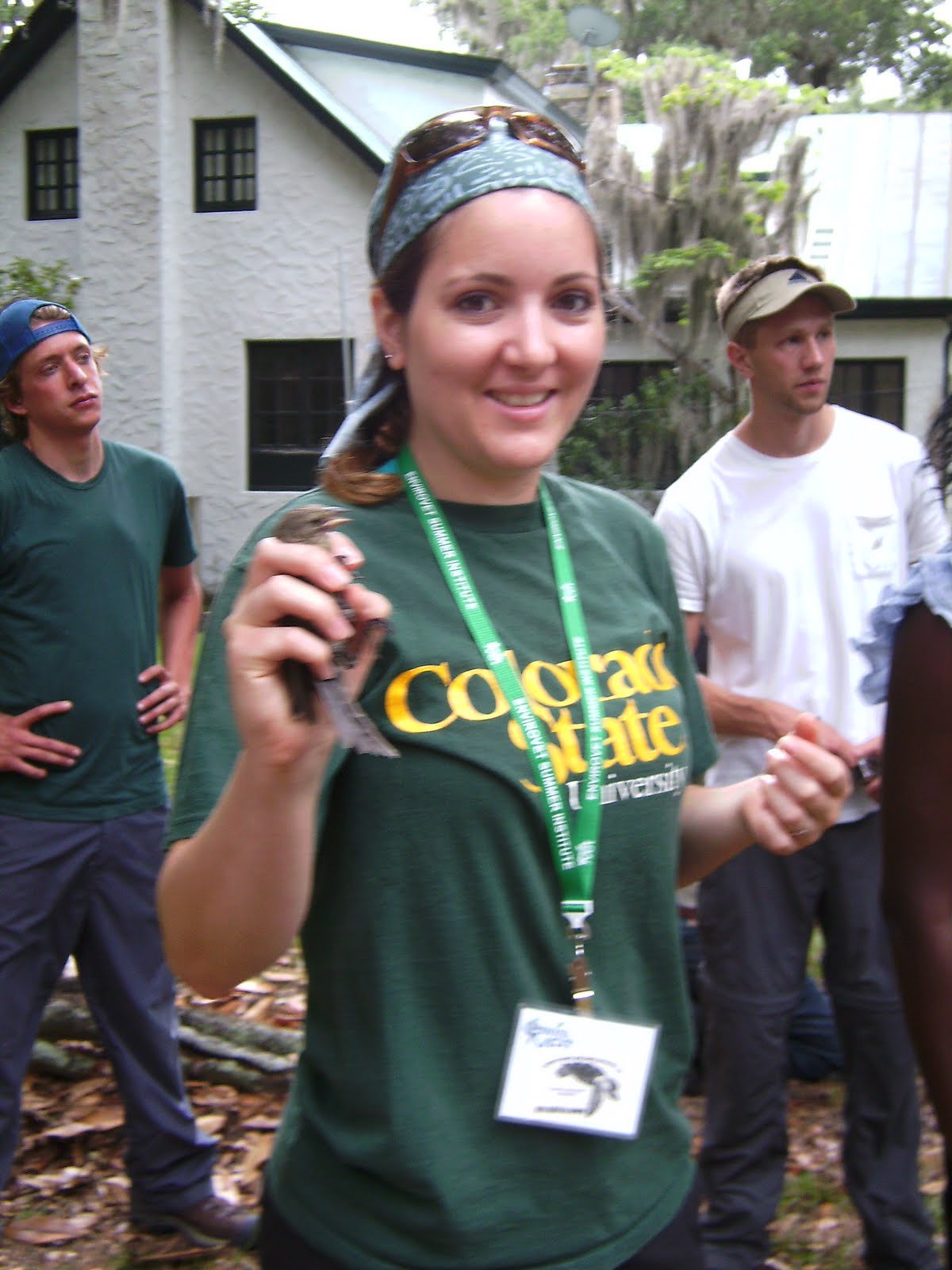
  Today we started with an orientation to bird sampling and surveillance.  We set up mist nets to catch small birds (cow birds, cardinals) and then we each got to practice our handling techniques.  Once we learned the basics we practiced removing the trapped birds from the mist nets - a tedious task!

Mastering the banding hold on a cow bird

  After lunch we learned a critical skill to any field researcher - orienteering!  We learned how to read maps, how to use GPS to identify your location, and how to use a compass to find your way to your destination.  An hour later we were headed into the depth of the forest to find our way to a secret destination - Wamassee Pond (home to a female alligator and her new babies).  My team was Amelie, Kemi, Ademola, Maya and Tricia.  When we arrived at our drop-off we found our coordinates on the GPS.  The team found our location on the map and used a few sophisticated tools (protractor, ruler) to find our direction (47 degrees - northeast!)  We made our way through the dense forest, passing intricate spiderwebs and toads under our feet.  Luckily no snakes or other large wildlife!  Before long our destination was in sight - and we were the first group to finish!  Go team!


Ademola, Tricia, me, Maya, Amelie, and Kemi at our destination - Wamassee Pond

  When we returned home we ate lunch and headed out into the field again.  This time we set traps for alligators, turtles, and frogs.  We will check our traps tomorrow and hopefully get to practice our reptile and amphibian sampling techniques.  Also tomorrow is radiotelemetry of the resident lemurs on St. Catherine's Island and health assessments of gopher tortoises.  Doesn't that sound like fun!?